Physical and nutritional assessment of fruits of Acrocomia aculeata (Jacq.) Lodd ex Mart. (Arecaceae) based on pulp color
Evaluación física y nutricional de los frutos de Acrocomia aculeata (Jacq.) Lodd ex Mart. (Arecaceae) con base en el color de la pulpa
Suelen Alves Vianna1, Priscila Aiko Hiane2, Mariana Nalesso Jordão2, Eduarda Carneiro da Costa2, Arnildo Pott3
1 Programa de Pós-Graduação em Agricultura Tropical
e Subtropical com ênfase em Genética, Melhoramento e
Biotecnologia Vegetal, Instituto Agronômico (IAC), Campinas,
São Paulo, Brasil. e-mail: suelen.loesch@gmail.com
2 Departamento de
Tecnologia de Alimentos e Saúde Pública, Universidade
Federal do Mato Grosso do Sul, Campo Grande,
Mato Grosso do Sul, Brasil.
3 Departamento de
Biologia. Programa de Pós-Graduação em Biologia
Vegetal, Universidade Federal do Mato Grosso do Sul, Campo Grande,
Mato Grosso do Sul, Brasil.
Date
received: July 24,
2013
Date approval: December 10, 2014 Associated Editor: Torres Torres M.
Abstract
Harverters select fruits of the
palm Acrocomia aculeata according to pulp color in order to manufacture
particular products being this one of the most important
characteristics of this fruit in the market. We conducted a study on
the physical and chemical characteristics of pulp of A. aculeate of
different colors. Pulp color was visually determined including the
following colors: yellow, orange, white, brown and pink for the
species. We observed a higher proportion of plants (34.3%) with yellow
pulp. We did not detect significant differences in physical
characteristics of equatorial length (cm), fresh mass of fruits (g),
fresh mass of pulp (g) and pulp yield (%) among different pulp colors.
We determined the components (g.100 g–1) moisture, total fats, proteins, fibers, fixed mineral residues and caloric value (kcal.100g-1) of pulps with different colors. Fruits with yellow pulp presented higher fat content (17.5±2.9 g.100 g–1) and, consequently, higher caloric value (249.4±30.3 kcal.100g-1). Ash content was significantly higher in the white pulp (3.17 g.100g-1),
compared with other colors. Pulp color does not influence quality, but
can be chosen to improve or make the final product more attractive. We
confirm the nutritive potential of this native palm.
Keywords: Extractivism, Native fruit, Natural food, Nutrient source, Palm, Plant resource.
Resumen
Se recolectan los frutos de la
palma Acrocomia aculeata de acuerdo con el color de la pulpa para
fabricación de productos, siendo el color la
característica más importante en su mercadeo; por esta
razón se realizó un estudio de las características
físicas y químicas de la pulpa con diferentes colores.
Los colores se determinaron visualmente incluyendo los siguientes:
amarillo, naranja, blanco, marrón y rosa para la pulpa de los
frutos de la especie. Se observó una mayor proporción de
plantas (34,3%) con la pulpa de color amarillo. Entre sus diferentes
colores no se detectaron diferencias significativas en las
características físicas de longitud ecuatorial (cm), la
masa de las frutas frescas (g), masa fresca de la pulpa (g) y el
rendimiento de la pulpa (%). Se determinaron los componentes (g.100 g-1) de humedad, grasas totales, proteínas, fibras, residuo mineral fijo y valor calórico (kcal.100g-1) de pulpas con diferentes colores. Las frutas con pulpa amarilla presentaron mayor contenido de grasa (17,5±2,9 g.100 g-1) y en consecuencia, un mayor valor calórico (249,4±30,3 kcal.100g-1). El contenido de cenizas fue significativamente mayor en la pulpa blanca (3,17 g.100g-1),
en comparación con otros colores. El color de la pulpa no
influyó sobre la calidad, pero el color elegido puede hacer el
producto final más atractivo. Se confirmó el potencial
nutritivo de esta palmera nativa.
Palabras clave: Comida natural, Extractivismo, Fruta nativa, Fuente de nutrientes, Palma, Recurso vegetal.
Introduction
Palms (Arecaceae) are among the
plants which most serve to people due to their versatility and
diversity of uses. Practically all parts of the palms are useful,
ranging from food to medical uses, with great economic importance
(Ellison 2001), providing abundant resources for several peoples
(Balick and Beck 1990). They are the plants which best
characterize landscapes, among species of tropical and subtropical
regions. Palms have the highest morphologic diversity within the
Monocotyledons (Uhl and Dransfield 1987), and nowadays they are
represented by c. 2,700 species distributed in more than 240 genera
(Lorenzi et al. 2010).
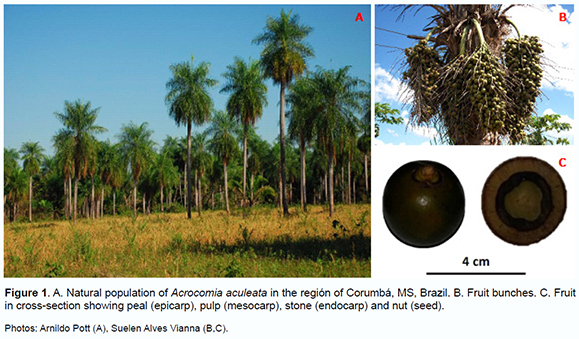
The palm Acrocomia
aculeata (Jacq.) Lodd. ex Mart. has a wide distribution and can be
found in the tropical and subtropical America, from southern Mexico to
northern Argentina (Henderson et al. 1995). It is evergreen,
heliophyte, monoecious, 4 to 15 m tall, being easily recognized for its
stipe covered with spines. The fruit is a drupe, with stony endocarp
(Henderson et al. 1995, Almeida et al. 1998, Moraes 2004, Lorenzi et
al. 2010) (Figure 1). In general, it flowers
and fructifies year round, with higher intensity in the rainy season,
the first fruit set occurring around the fourth or fifth year after
germination (Almeida et al. 1998). Because of its wide geographical
distribution, the phenology varies according to the region.
The common name of the
species varies according to the region of occurrence, being known in
Brazil mainly as «macaúba», country in which it is
also called «mucajá», «coco-de-catarro»,
«chiclete-de-baiano», «bocaiúva», among
others. It is also called «mbocayá» in Argentina,
«totaí» in Bolivia, «corozo» in Colombia
and Venezuela, «tamaco» in Colombia, «corosse»
in Haiti, «coyol» in Costa Rica, Honduras and in Mexico, in
France «noz de coyol», in Spain «amankayo» and
other names, and in Germany «coyoli Palme» (Almeida et al.
1998, Carvalho et al. 2011, Hernández et al. 2011).
Acrocomia aculeata is a
palm of multiple uses, since all its parts can be utilized. In Brazil,
the leaves are used as good forage (Santos et al. 1997), source of
textile fiber for confection of hammocks and fishing lines, handicrafts
and cover and/or to build houses (Nucci 2007). The stem can be utilized
as poles and to build fences. The endocarp (stone) has been used to
replace gravel in concrete or for production of good quality charcoal
(Toledo 2010). The nut gives excellent oil, equivalent to olive oil,
that can be utilized either as human food or to manufacture cosmetics,
waxes and other products. In Central American countries it is common
the fermentation of the sap from the stem to produce an alcoholic drink
known as «vino de coyol» (Balick and Beck 1990, Lentz
1990). In Mexico, a liqueur called «taberna» is made from
it (Hernández et al. 2011). In addition, the whole fruit can be
used in the preparation or a dessert, just pealed. There are reports of
its use in Brazil for medicinal purposes, as strengthener (pulp), as
painkiller (pulp oil), and as laxative (nut oil). In the same way it is
used in Mexico against worms (nut) and diabetes (root infusion)
(Hernández et al. 2011).
With regard to the pulp,
it can be consumed fresh or processed as flour, ice cream, cakes and
other food items (Vianna et al. 2012, Hernández et al. 2011,
Ramos et al. 2008). There is a growing interest represented by an also
higher number of studies regarding composition of its oil for
application as biofuel.
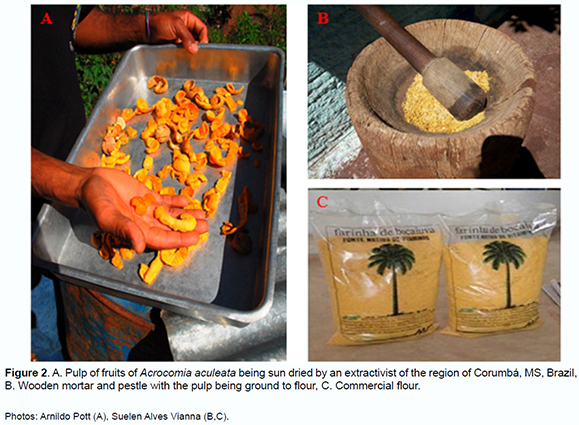
A large variation in
size, weight, color of the peal and color of the pulp have been
reported by the harvesters of fruits of A. aculeate at the municipality
of Corumbá, MS, Brazil, region of the Pantanal wetland. In this
region, the fruits are collected by small rural producers, who sale the
pulp or the flour made out of this, a typical regional product (Figure 2).
Harvest is mainly based on pulp color, since the final product is
differentiated according to that. In general, fruits with pulp of
orange tones look more attractive and, therefore, are sold as frozen or
dehydrated pulp for consumption in natura and for ice cream, and those
of yellow color are mainly used to prepare flour.
Although there are
available reports on the nutrient composition of the Acrocomia species
(Hernández et al. 2011, Ramos et al. 2008, UNICAMP 2011),
very few studies relate the nutritional attributes of the fruits and
the diversity of colors observed among them. Rural extractivist
communities use to associate the highest oil contents to fruits of
yellow or orange pulp color. Berton (2013) found values of oil
concentration above 70% for fruits with orange pulp. Given the
importance of pulp color for extractivist, we study the physical
characteristics and of the centesimal composition of fruits of A.
aculeata with different pulp colors, in order to verify the existence
of chemical compounds or physical factors influencing the quality of
the final products. We hope that our analysis will help to determine
those characteristics associated with the most appropriate fruits for
harvest and processing. Another relevant factor to keep in mind is that
due to its wide geographic distribution and adaptability, the
species is an alternative of economical exploration for low income
people or also for large commercial crops, not only in Brazil.
Methodology
Sampling area.
Considering the great economic potential of the species, our study was
undertaken in three areas situated on the Western edge of the Pantanal
wetland, at the municipality of Corumbá, Mato Grosso do Sul,
Brazil. There are large natural populations of the species used by
local people working on extracting and processing of the pulp. The
study area is disturbed, with secondary vegetation, predominantly
Urochloa spp. grasslands for cattle. Soils are mainly clayey and
calcareous, fertile, but shallow (Cardoso et al. 2002), often
unsuitable for crops. The climate of the region according to
Köppen-Geiger classification is type Aw-tropical, megathermal,
with seasonal annual rainfall of 1,070 mm (Cadavid-Garcia 1984; Soriano
1997).
Sampling and characterization of fruits. We
selected 70 plants with fruits showing differentiated pulp colors, at
ripening stage, as indicated by fruit drop on the ground. We harvested
two bunches per plant for the analyses.
We counted all fruits on
each collected bunch, and then we removed 50 fruits at random from each
bunch, weighed them on a precision scale and measured them for polar
length (cm) and equatorial width (cm) using a caliper and visually
determined pulp color.
Centesimal composition of the pulp. In
addition to the fruits used for physical characterization, we removed
100 fruits from each bunch, then manually pealed and pulped them. The
pulp was homogenized in a food processer, packed and stored at
-20°C until the onset of the chemical analyses (Ramos et al. 2008).
For analyses, the homogenized pulp of each fruit lot was dried in a
forced air oven at 40ºC and ground in Tecnal mill mod TE 631.
For analysis of
centesimal composition of the samples, we followed methods described in
the analytic rules of Instituto Adolfo Lutz (Ministério da
Saúde 2005). The determination of moisture was performed by
desiccation in oven at 105°C (gravimetric method), the total
fat content was determined by the method of direct extraction with
organic solvent in Soxhlet extractor, ashes (fixed mineral residue)
determined by burning in muffle oven at 550°C (gravimetric method),
and carbohydrates evaluated by the method of Lane-Eynon (reduction
method). The protein content was determined by total nitrogen content
(%), after the method of microKjeldahl, using the factor 6.25 for
conversion of nitrogen in protein, described by the Association of
Official Analytical Chemists (AOAC) (1992). Fiber was obtained by
difference between 100 g and the total grams (%) of moisture, protein,
fats, ashes and carbohydrates (Ramos et al. 2008).
Total energy from nutrients was expressed in kilocalories (kcal), estimated by conversion factors of Atwater:
kcal = (4 x g protein) + (4 x g carbohydrates)
+ (9 x g fats) (Ramos et al. 2008).
Statistical analyses. The independent and nominal sampling data were submitted to qui-square (X2)
test aiming to verify the existence or not of association among
the variables of quantity and pulp color (Zar 1999). The results of
physical characteristics and nutritional composition were
statistically analyzed using ANOVA with post-Tukey test at 5%, for
detection of difference among groups of fruits with different color.
Results and discussion
Physical characteristics of the fruits.
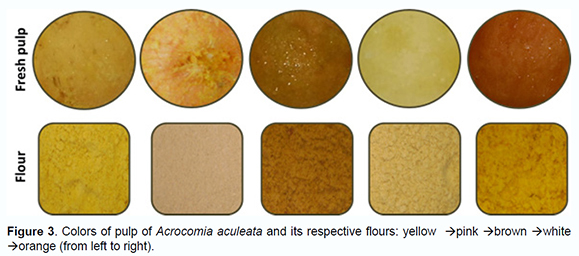
After observations and dialogue with extractivists, we determined five
colors of pulp of A. aculeata: yellow, pink, brown, white and orange,
observing (but not evaluated variation) tones within those colors,
e.g., dark and light yellow (Figure 3). We
point out that these colors were determined on fruits harvested from
bunches which presented fruit dropping (sign of ripening), therefore
the colors were not influenced by degree of ripeness.
We observed that 34.3%
of the analyzed plants presented fruits with yellow pulp, followed by
plants with orange pulp (30%), plants with fruits of brown pulp
(17.1%), white pulp (10%) and pink pulp (8.6%). The herein observed
diversity of the assessed pulp colors as well as the previously
reported variation in pulp color demonstrates a high intra and inter
population variability of this characteristic in this palm species.
Besides pulp color, A. aculeate presents high variation in other
parameters (plant height, absence of spines, etc.) that can be selected
and used in breeding programs aiming to increase productivity and
quality of the final product.
Reports made in other
regions confirm the existence of a diversity of pulp colors within and
among populations of A. aculeata. However, fewer colors, e.g., Silva
(2009) qualified as whitish for the fruits sampled in the State of
Minas Gerais. Azevedo Filho et al. (2009) described the mesocarp color,
of fruits collected in the States of Minas Gerais and São Paulo,
in three yellow tones (light, medium and dark) and white.
Regarding the evaluated physical parameters, we did not find significant differences among fruits with different pulp colors (Table 1), suggesting that pulp color does not influence fruit biometry, consequently not altering pulp yield. The X2 test demonstrates that there was no significant association between pulp color and quantity (pulp weight), (p=0,179).
Regardless color, the
contribution of the pulp presents a good yield for culinary
preparations and as well as a source of potentially nutritive food
(53.4% in average), similar to the value determined by Ramos et al.
(2008) (44.2%).
Centesimal composition.
Although not statistically supported, we observed differences in
lipid content and consequently total caloric value (TCV) among the
different pulp colors. The highest lipid content (17.53±2.89
g.100 g–1) and TCV (249.38±30.28 kcal.100g-1) were found in yellow pulp fruits, and the lowest oil content (8.56±2.33 g.100 g–1) and TCV (167.19 ±24.67 kcal.100g-1) were associated with pink pulp fruits (Table 2).
Remarkably, the lowest TCV determined in our work (167.19 kcal.100g-1
– pink pulp), has an energetic potential value nearly three times
higher than the one reported for the pulp of the
«Açaí» (Euterpe oleracea Mart. 58 kcal.100g-1), and twice as high as the one found in the pulp of the «Buriti» (Mauritia flexuosa L. f. 85.9 kcal.100 g–1) (UNICAMP 2011, Ramos et al. 2008), two of the most consumed palms in Brazil
.
Such energetic potential, which is estimated under cultivation as 4,966 L.ha.year-1,
besides being used as food, arouse interest for its utilization as
biofuel, with much higher yield than other crops commonly utilized for
such purpose, e.g., soybean (Glycine max (L.) Merr.), sunflower
(Helianthus annuus L.) and castor oil (Ricinus communis L.), that
produce 420, 890 and 1,320 L.ha.year-1, respectively.
We only verified
significant differences among different pulp colors for «fixed
mineral residue» (ashes), with an ash content higher in fruits
with white pulp (3.17 g.100g-1) (Table 2).
The nutritional
composition shown in our work for A. aculeata fruits (with pulp of all
colors), agrees with the recommended daily ingestion of fiber and
carbohydrates and is in pace with the acceptable range of daily fat
intake in human diet (National Academies Press 2002/2005,
Ministério da Saúde 1998).
Considering that the
species is native in the region and can be easily found in large
natural populations, our study shows the potential of A. aculeate as a
promising source of for nutritional and technological products, that
can make a difference for rural communities economy and quality of life
of the people involved in extractivism or cultivation.
Conclusions
The fruit A. aculeata presents
a good pulp yield, demonstrating to be a good candidate to be used for
culinary preparations, technological uses, and as source of nutritive
food, independently of its color. Although extractivists select A.
aculeata fruits for pulp color, we show that there is no significant
difference for the majority of the nutritional components among
fruits with different pulp color; hence, any pulp color can be used for
fabrication of flour or any other product without loss of the final
quality. Nevertheless the colors can be chosen in order to improve the
final product or to make its visual aspect more attractive.
In view of the diversity
of existing carotenoids, and that they among other factors are
responsible for fruit color, plus being important compounds for human
health, we suggest research on composition of carotenoids considering
different pulp colors of A. aculeata.
Acknowledgements
To Coordenação de
Aperfeiçoamento de Pessoal de Nível Superior (CAPES) for
a Visiting Professor grant to A. Pott and scholarship during Master
work and to Fundação de Amparo à Pesquisa do
Estado de São Paulo (FAPESP) for present financial support and
the doctoral supervisor Carlos Augusto Colombo (Instituto
Agronômico de Campinas) to the first author, for their support
during the review of this article; to Departamento de Tecnologia de
Alimentos e Saúde Pública da Universidade Federal de Mato
Grosso do Sul and to Embrapa for logistic support.
Literature cited
- Almeida SP.
Proença CEB, Sano SM, Ribeiro JF. 1998. Cerrado-Espécies
vegetais úteis. Brasília: Embrapa Cerrados; xiii+464 pp.
- Association of Official
Agricultural Chemists. 1992. Official methods of analysis of the
Association of the Agricultural Chemists. 12 ed. Washington, DC: AOAC.
- Azevedo Filho JA, Berton
LHC, Colombo CA, Coelho RM. 2009. Biometria de frutos de macaúba
coletados nos estados de São Paulo e Minas Gerais. Montes
Claros, Anais. 6º Congresso de Plantas Oleaginosas, Óleos,
Gorduras e Biodiesel.
- Balick MJ, Beck HT. 1990. Useful palms of the world: A synoptic bibliography. New York: Columbia University Press; 701 pp.
- Ministério da
Saúde, Agência Nacional de Vigilância
Sanitária (ANVISA). 2005. Métodos
físico-químicos para análise de alimentos.
Brasília: Ministério da Saúde; 1018 pp.
- Ministério da
Saúde. Secretaria de Vigilância Sanitária. 1998.
Portaria n° 31, de 13 de janeiro de 1998. Regulamento
técnico para fixação de identidade e qualidade de
alimentos adicionados de nutrientes essenciais. Diário Oficial
da República Federativa do Brasil, Brasília, 16 de
janeiro de 1998.
- Universidade Estadual de
Campinas (UNICAMP). 2011. Tabela Brasileira de Composição
de Alimentos (TACO). 4ª ed revisada e ampliada. Campinas: UNICAMP;
164 pp.
- Berton LHC. 2013.
Diversidade, estimativas de parâmetros genéticos e
seleção de genótipos elite de Macaúba
(Acrocomia aculeata). 163 f. 2013. Tese,
Pós-graduação em Agricultura Tropical e
Subtropical, São Paulo: Centro de Recursos Genéticos
Vegetais, Instituto Agronômico de Campinas.
- Cadavid-Garcia EA. 1984.
O clima no Pantanal Matogrossense. Circular técnica, 14.
Corumbá: Embrapa Pantanal; 39 pp.
- Cardoso EL, Spera ST,
Pellegrin LA, Spera,MRN. 2002. Solos do Assentamento Urucum. Documentos
30. Corumbá: Caracterização,
limitações e aptidão agrícola.
Corumbá: Embrapa Pantanal; 35 pp.
- Carvalho KJ, Souza AL,
Machado CC. 2011. Ecologia, manejo, silvicultura e tecnologia da
Macaúba. Convênio de Cooperação
Técnica SECTES/FAPEMIG, Pólo de Excelência em
Florestas. Viçosa: Universidade Federal de Viçosa; 38 p.
- Ellison A. 2001. Cultivated palms on the world. Australian: UNSW Press Book. 257 pp.
- Henderson A, Galeano G, Bernal R. 1995. Field guide to the palms of the Americas. Princeton: Princeton University; pp. 166-7.
- Hernández BCR,
Hernández J, Verduzco JEGA, Frier JP, Barrios EP,
Martínez MAG. 2011. Importancia agroecológica del coyul
(Acrocomia mexicana Karw. ex Mart.). Est Soc. 21 (41): 96-113.
- Lentz DL. 1990. Acrocomia mexicana: Palm of the ancient Mesoamericas. J Ethnobiol. 10 (2):183-94.
- Lorenzi H, Kahn F,
Noblick LR, Ferreira E. 2010. Flora brasileira-Arecaceae (Palmeiras).
Nova Odessa: Instituto Plantarum; 368 pp.
- Moraes RM. 2004. Flora de palmeras da Bolívia. La Paz: Plural Editores. 484 pp.
- National Academies Press.
2002/2005. Dietary reference intakes for energy, carbohydrate. Fiber,
fat, fatty acids, cholesterol, protein, and amino acids.
Disponível em: <http://www.nal.usda.gov> Washington, DC: National Academies Press.
- Nucci SM. 2007.
Desenvolvimento, caracterização e análise da
utilidade de marcadores microssatélites em genética de
população de macaúba. 84 f.
Dissertação (Mestrado em Agricultura Tropical e
Subtropical), Campinas: Instituto Agronômico de Campinas.
Disponível em: http://www.iac.sp.gov.br/PosIAC/pdf/pb1206305.pdf. Acesso em 11/04/2011.
- Ramos MIL, Ramos Filho
MM, Hiane PA, Braga Neto JA, Siqueira EMA. 2008. Qualidade nutricional
da polpa de bocaiúva Acrocomia aculeata (Jacq.) Lodd.
Ciência e Tecnologia de Alimentos. 28 (Supl.): 90-4.
- Santos SA, Rodrigues CAG,
Afonso E, Sereno JR, Soares ACC. 1997. Utilização das
folhas da Bocaiúva e do Acuri como suplemento alimentar para
equinos no Pantanal. Embrapa Pantanal. Comunicado Técnico, 19.
Corumbá: Embrapa Pantanal. 8 pp.
- Silva ICC. 2009. Uso de
processos combinados para aumento do rendimento da
extração e da qualidade do óleo de Macaúba.
Dissertação (Mestrado em Tecnologia de Processos
Químicos e Bioquímicos). Rio de Janeiro: Universidade
Federal do Rio de Janeiro, Escola de Química, Programa de
Pós-Graduação em Tecnologia de Processos
Químicos e Bioquímicos, 99 f. Disponível em: http://www.eq.ufrj.br/sipeq/download/aumento-da-qualidade-do-oleo-de-macauba.pdf
- Soriano BMA. 1997.
Caracterização climática de Corumbá-MS.
Embrapa Pantanal. Boletim de Pesquisa, 11. Corumbá: Embrapa
Pantanal. 25 pp.
- Toledo DP. 2010.
Análise técnica, econômica e ambiental de
macaúba e de pinhão-manso como alternativas de
agregação de renda na cadeia produtiva de biodiesel.
292f. Dissertação (Magister Scientiae). Viçosa:
Universidade Federal de Viçosa.
- Uhl NW, Dransfield J.
1987. Genera Palmarum. A classification of palms based on the work of
Harold E. Moore. Lawrence: Jr. Allen Press. 610 pp.
- Vianna SA, Hiane PA,
Jordão MN, Pott A, Silva RH, Borsato AV. 2012. Potencial
nutricional y uso de los frutos de Acrocomia aculeata (Jacq.) Lodd. ex.
Mart. en el Pantanal (Mato Grosso do Sul, Brasil). In: II Congreso
Boliviano de Botánica; III Congreso Latinoamericano de
Etnobiología; I Simposio Boliviano de Etnobotánica,
La Paz, Bolivia. Memorias del Congreso. La Paz, Bolivia: Sociedad
Latinoamericana de Etnobiología.
- Zar JH. 1999. Biostatistical analysis. 4 ed. Upper Saddle River: Prentice Hall. 663 pp. http://www.tropicos.org