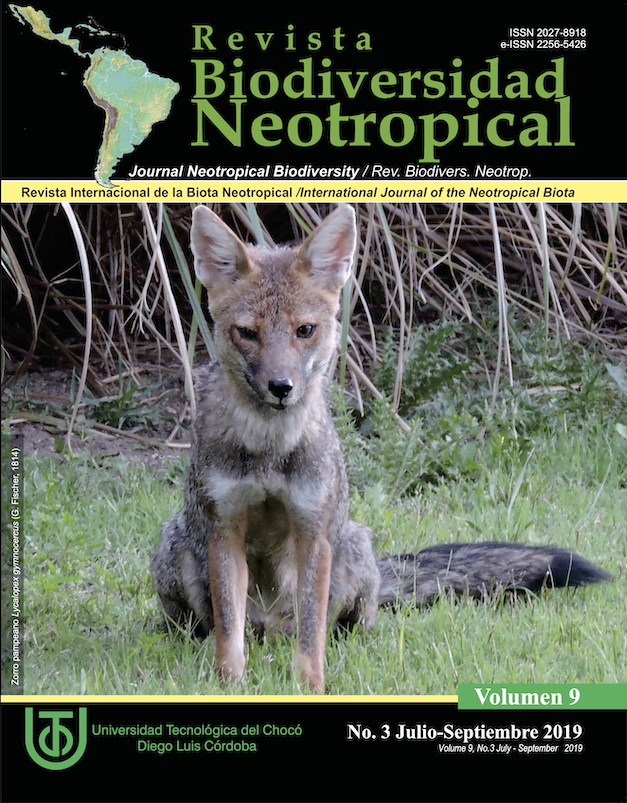
Effect of carnivorous diet by the Pampas grey fox (Lycalopex gymnocercus) on spiny hackberry (Celtis ehrenbergiana) germination
DOI:
https://doi.org/10.18636/bioneotropical.v9i3.804Keywords:
Carnivorous diet, Celtis ehrenbergiana, Endozoochory, Germination, Pampas foxAbstract
Pampas fox (Lycalopex gymnocercus) has a generalist omnivorous diet consuming numerous species of fruits, among which are the Celtis ehrenbergiana fruit (locally called “tala”). However, the diet of these animals can vary depending on the environment. The effect that an exclusively meat diet can have on these fruits is unknown. Objectives: a) to know if the seeds of C. ehrenbergiana suffer physical damage when passing through the digestive tract of Pampas foxes when they are fed exclusively meat; b) to explore whether a carnivorous diet affects seed viability, beginning of germination, power and germination rate. Methodologic: Germination was compared between seeds collected directly from the fruits and those obtained from feces of foxes in captivity fed exclusively on meat. Each treatment had 300 seeds (10 plates of 30 seeds each) that were placed in a germinator at a constant humidity and temperature of 25°C for 234 days. Results: Seeds of C. ehrenbergiana were not physically damaged when passing through the digestive tract of the Pampas fox and their germination power was 2.4 times higher than the seed of the fruits (t=-0.19; p=1*10-6). Conclusion: The effect of the passage of the seeds through the digestive tract of the Pampean fox would be beneficial for C. ehrenbergiana when the animals maintain carnivorous diets.
Downloads
References
Bradbeer, JW. 1998. Seed dormancy and germination. Chapman and Hall; 150 pp.
Biloni, JS. 1990. Árboles autóctonos argentinos. Buenos Aires: Tipográfica Editora Argentina; 1-230 pp.
• Cabrera, AL. 1976. Regiones fitogeográficas Argentinas. Buenos Aires: 2ed. Enciclopedia Argentina Agrícola y Jardinería; 85 pp.
• Cottrell HJ. 1947. Tetrazolium salt as a seed germination indicator. Nature. 159: 1-748.
Dellafiore CM. 2018. ¿Afecta el zorro (Lycalopex gymnocercus) la germinación de Pyracantha atalantoides (rosaceae)?. Mastozool. Neotrop. 25 (1): 53-58.
Dellafiore CM., Brignone E. 2019. Rol ecológico del zorro como dispersor de semillas en ambientes de agroecosistema y bosques serranos de Argentina. Memorias XII Convención Internacional Sobre Medio Ambiente y Desarrollo.
Duarte, C., Dellafiore CM. En prensa. Efecto de la endozoocoria por el zorro gris pampeano (Lycalopex gymnocercus) (Carnívora: Canidae) sobre la germinación del tala (Celtis ehrenbergiana) (Rosales: Cannabaceae). Cuadernos de Investigación UNED Research Jorunal.
Farias AA., Kittlein MJ. 2008. Small-scale spatial variability in the diet of pampas foxes (Pseudalopex gymnocercus) and human-induced changes in prey base. Ecol. Res. 23: 543–550.
Herrera, CM. 1989. Seed dispersal by animals: a role in Angiosperm diversification? Amer. Naturalist. 133 (3): 309-322.
Izhaki I, Ne’eman G. 1997. Hares (Lepus spp.) as seed dispersers of Retama raetam (Fabaceae) in sandy landscape. J. Arid Environ. 37: 343-354.
Mackay DB. 1972. The measurement of viability. Viability of seeds. Chapman and Hall; 172-208 pp
Medel, R., Jaksic F. 1988. Ecología de los cánidos sudamericanos: una revisión. Rev. Chil. Hist. Nat. 61: 67—79.
Nuñez MB., Bozzolo L. 2006. Descripción de la dieta del zorro gris, Pseudalopex griseus (Canidae) (Gray, 1869), en el Parque Nacional de las Quijadas, San Luis, Argentina. Gayana. 70 (2): 163-167.
Romanczuk, MC., Del Pero De Martínez MA. 1978. Las especies del género Celtis (Ulmaceae) en la flora argentina. Darwiniana. 21(2/4): 541—577
Suárez‐Esteban, A., Delibes, M., Fedriani, JM. 2013. Barriers or corridors? The overlooked role of unpaved roads in endozoochorous seed dispersal. J. Appl. Ecol. 50 (3): 767-774.
Traveset A. 1998. Effect of seed passage through vertebrate frugivores’ guts on germination: a review. Perspectives in Plant Ecology. J Syst Evol. 2:151-190.
Varela O., Cormenzana-Méndez A., Kaprovickas L., Bucher E. 2008. Seasonal diet of the pampas fox (Lycalopex gymnocercus) in the Chaco dry Woodland, nortwestern Argentina. J. Mammal. 88 (2): 519-525
Willson, MF.1993. Mammals as Seed-Dispersal Mutualists in North America. Oikos. 67: 159-176.
Published
How to Cite
Issue
Section
License
Copyright (c) 2022 JOURNAL OF NEOTROPICAL BIODIVERSITY

This work is licensed under a Creative Commons Attribution-NonCommercial-ShareAlike 4.0 International License.
Los autores que publican en esta revista están de acuerdo con los siguientes términos: Los autores conservan los derechos de autor y garantizan a la revista el derecho de ser la primera publicación del trabajo al igual que licenciado bajo una Creative Commons Attribution License que permite a otros compartir el trabajo con un reconocimiento de la autoría del trabajo y la publicación inicial en esta revista. Los autores pueden establecer por separado acuerdos adicionales para la distribución no exclusiva de la versión de la obra publicada en la revista (por ejemplo, situarlo en un repositorio institucional o publicarlo en un libro), con un reconocimiento de su publicación inicial en esta revista. Se permite y se anima a los autores a difundir sus trabajos electrónicamente (por ejemplo, en repositorios institucionales o en su propio sitio web) antes y durante el proceso de envío, ya que puede dar lugar a intercambios productivos, así como a una citación más temprana y mayor de los trabajos publicados (Véase The Effect of Open Access) (en inglés).