Vol. 4 No. 1 Ene-Jun (2014)
As another step in our goal to consolidate the journal Biodiversidad Neotropical as a key mechanism of scientific communication of the Neotropical biota, we present to the scientific community our seventh number. The happiness that represents this new number, contrasts with the deep feelings caused by the loss of one of our editorial team members: Camilo Ernesto Rincón-López «Cami», a young and active scientist who dedicated his efforts to the understanding of the Neotropical fish fauna. We dedicate some pages of this volume to his memory (In memorian).
To honor people such as Camilo Rincón and José Ayarzaguena, who contributed to the creation of Biodiversidad Neotropical, we maintain our compromise to grow. On this line of ideas, we currently are in the process of indexation of the journal in other international index sites such as: Redalyc, Cab Abstracts, Dialnet, and SciELO. In addition, Biodiversidad Neotropical is now available at Google Scholar, an academic global search tool.
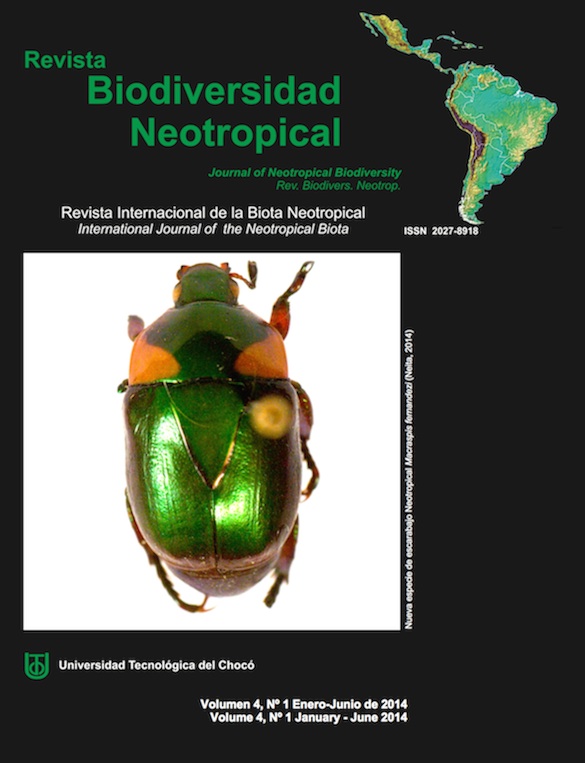
In accordance with our mission, for this number we present the description of a new species of Neotropical beetle in the genus Macrapsis from the Serranía de la Macarena, an independent mountain range in Colombia. We also document the first record of jaguar (Panthera onca) for the northern portion of the Colombian Biogeographic Chocó as product of samplings with camera traps; two new populations of howler monkeys are also introduce for the province of Huancabamba, Piura, in Perú; this number includes the list of reptiles and amphibians for the Reserva de Biósfera Ñacuñan (Argentina) and the list of anurans associated with the area of the Centro de Investigación Amazónica Macagual, Florencia, in the Colombian Amazon.
In this number the readers will find an evaluation of lichens as bioindicators of air quality in urban areas, highlighting the importance of this group of organisms as indicators of gradients of atmospheric contamination in non-industrialized urban centers. A group of researchers present an analysis of the relationship between body size and environmental conditions for Oophaga pumilio at the biological station La Selva, in Sarapiquí, Costa Rica. Finally, we present results of the isolation and identification of secondary metabolites present in Aciotis polystachya, with Quercetina and Kaemferol as newly reported metabolites for the species and the genus.
It is our desire for the reader to enjoy the variety of subjects in this number and we hope that the effort of our team in the construction of this number, as well as the In memorian of Camilo Rincón will be a fair tribute to the memory of our beloved colleague.
Alex Mauricio Jiménez-Ortega
Editor